Heroes Go Beyond!
How My Hero Academia channels the Iliad by defining heroism as acknowledging a shared humanity
Spoiler warning for major plot points
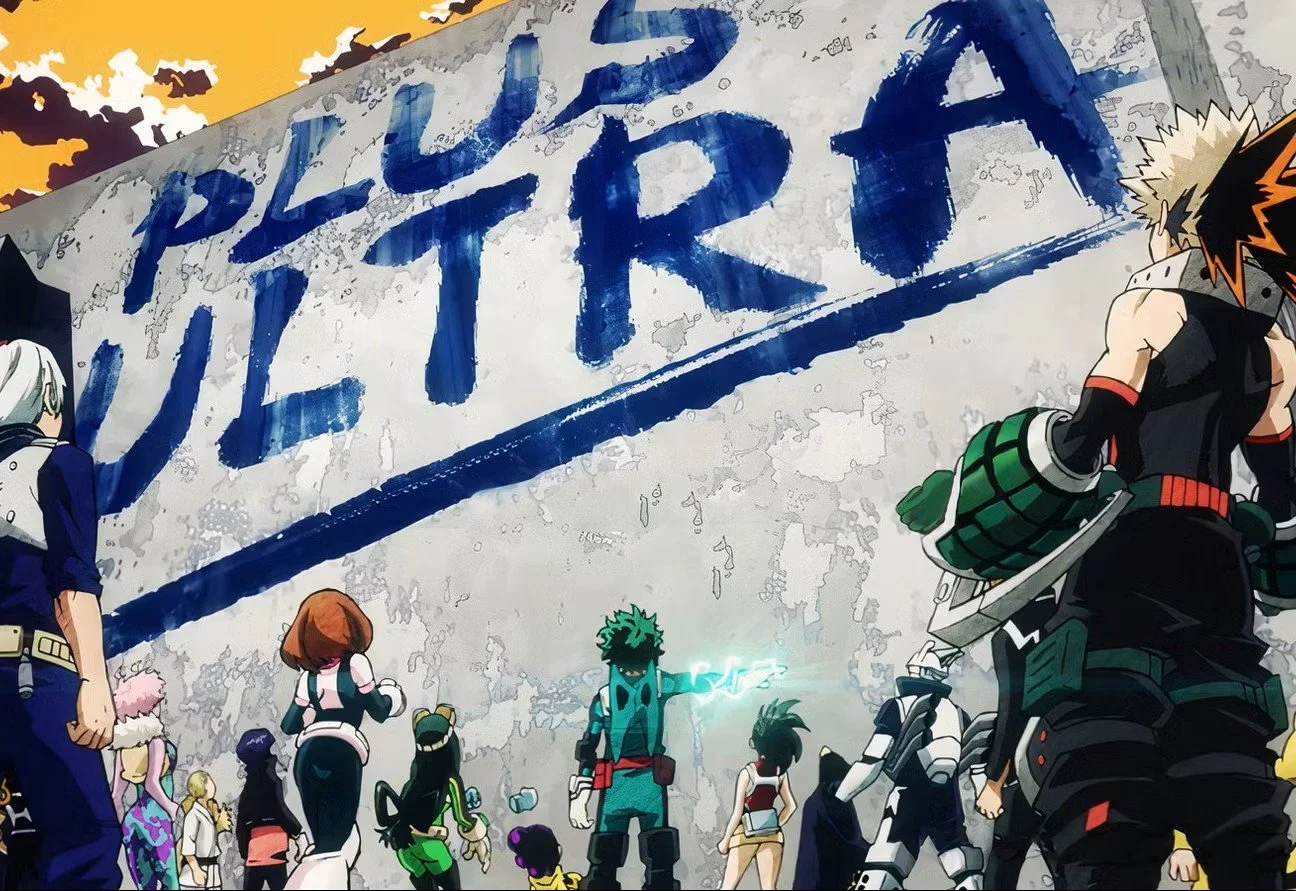
“Plus Ultra!” - “Go Beyond!” - both the defining motto of My Hero Academia and its connection to the Iliad
“You CAN be a hero!” As All Might’s words thundered against the setting sun, Midoriya “Deku” Izuku - the protagonist of My Hero Academia - collapsed to his knees in tears. The world’s number one hero had just affirmed Midoriya’s childhood dream, despite him lacking any superpowers, after witnessing Midoriya leaping without hesitation to save a friend. I argue that this declaration carries far more weight than just another kickoff to a shounen series; it links My Hero Academia to an idea of heroism sung over 3,000 years ago in Homer’s Iliad, specifically in the character arc of another legendary hero: Achilles.
From the first myths to modern-day superhero comics, stories across multiple civilizations and millennia have wrestled with the question of “what does it mean to be a hero?” I argue that both the Iliad and My Hero Academia converge on a similar definition of heroism. This work sets out to demonstrate why the return of Hector’s body – who was Achilles’s greatest foe – to his father King Priam represents Achilles’s ascension to a “true hero,” and why My Hero Academia’s motto of “Plus Ultra” – Go Beyond – channels the same message: that heroism emerges from the acknowledgement of a shared humanity.
Heroes are commonly thought of as those with the greatest martial ability and/or those with divine lineage. This usually means their heroism is measured by the ferocity of foes overcome. At first glance, the lliad endorses this concept, for it is an extremely violent poem. The Iliad takes place during the tenth year of the Trojan War, waged between Greece and Troy, with at least half the poem dedicated to events on the battlefield. While the poem does not shy away from graphic descriptions of the carnage, these descriptions are often intertwined with idyllic imagery that paint war as a necessary, and sometimes almost beautiful, undertaking:
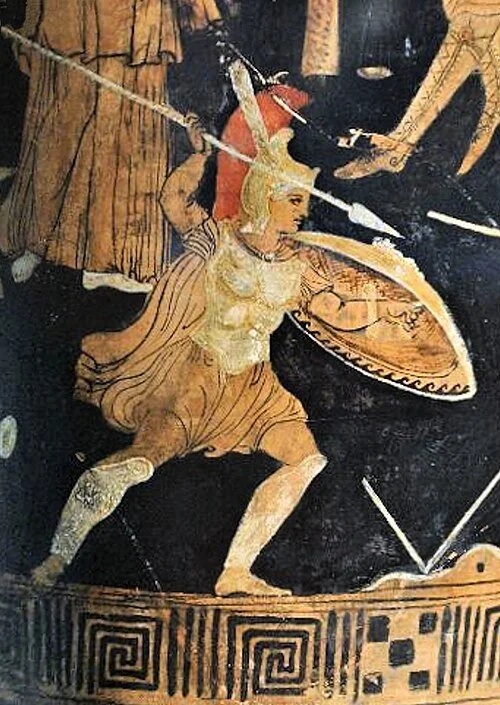
“Achilles storming on with brandished spear/
Like a frenzied god of battle trampling all he killed/
… Thundering on/ on like oxen broad in the brow some field hand yokes/
To crush white barley heaped on a well-laid threshold floor…” [1]
These oxymorons suggest that within the world of the Iliad, winning glory through war is just as admirable as, and even inseparable from, cultivating a prosperous life during peace. To be an upstanding moral citizen is to be just as skilled at bloodshed as providing for one’s family. Thus, excelling at warfare is a necessary step to be considered a hero in the standard Iliad canon.
While the Iliad’s famous cast all excel in martial prowess, from wily Odysseus to ruthless Agamemnon, from dauntless Diomedes to mighty Sarpedon, it is wrathful Achilles of Greece and noble Hector of Troy who stand above them all. Within the Iliad´s world, Achilles is the zenith of a traditional hero. Born a demi-god and boasting of invulnerability save for his infamous heel, he is the personification of violence as a one-man army on the battlefield. And yet for all his gifts, Achilles lets his rage overwhelm his wits when he is denied his rightful battlefield glory, and thus withdraws from the war. This decision “cost the [Greeks] countless losses/ hurling down to the House of Hades countless souls…”[2] Achilles may be a hero in the martial and divine birth sense, but no more. In fact, he could even be considered inhuman, in the sense that Achilles’s inability to see beyond his own suffering caused far more death and destruction for Greeks than necessary.[3]
On the flip side, Hector introduces us to another vision of a hero. Although he is mortal, he represents the pinnacle of a civilized man at that time – not just a warrior, but also a man dedicated to family and country. Hector demonstrates this depth of character during one of the most touching scenes in the Iliad, when he snatches a moment’s respite behind the city walls with his wife and infant son.
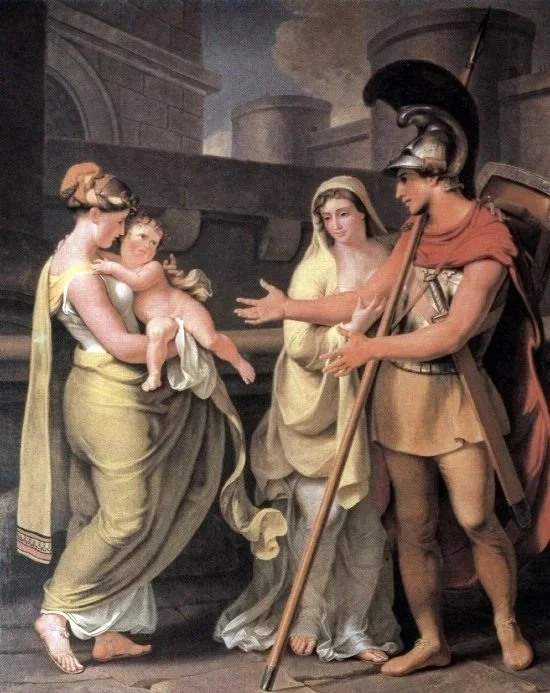
“… Shining Hector reached down/
for his son – but the boy recoiled/ …
terrified by the flashing bronze, the horsehair crest,/
the great ridge of the helmet nodding, bristling terror/
… And his loving father laughed,/
his mother laughed as well, and glorious Hector/
quickly lifting the helmet from his head/
… raising his son he kissed him, tossed him in his arms…” [4]
But this tender moment is fleeting, and Hector rushes back to the battlefield, knowing that he bears the survival of Troy’s royal lineage and its people on his back. Hector shows he is everything that Achilles is not. Despite also existing in the violent world of the Iliad, Hector’s presence suggests that there’s an alternate version of a hero – one who uses his might to protect something larger than oneself – thus subverting the standard canon of pure martial might equals right.
And here’s where the genius of the poem emerges. When Achilles slays Hector during the Iliad’s epic climax, the poem’s language is not triumphant, but heart-wrenching. Hector’s death represents the vanquishing of Troy’s “hero,” and appears to suggest the victory of violence over civilization. The poem could have ended there, with an image of Achilles at the epitome of his martial might. But was that really the definition of a hero that the Iliad sought to immortalize?
The ending of the poem suggests otherwise, as its final stanzas sing of Achilles returning the body of Hector to his father, King Priam. Although Achilles is initially ready to send Priam away and continue mutilating Hector’s body, he finally relents when Priam appeals to Achilles’s own humanity. Priam reminds Achilles that his own father will soon lose a son. This act finally quells Achilles’s rage, as he sees his father reflected in Priam. This acknowledgement establishes a connection with Priam not as demi-god and king, but as a son and a father - a human connection. By recognizing that he and Priam share a common humanity, Achilles finally ascends to Hector’s version of a hero; one that can see beyond his individual glory. The Iliad seems to say that amidst this world of violence, it’s acknowledging each other’s humanity that makes a true hero.
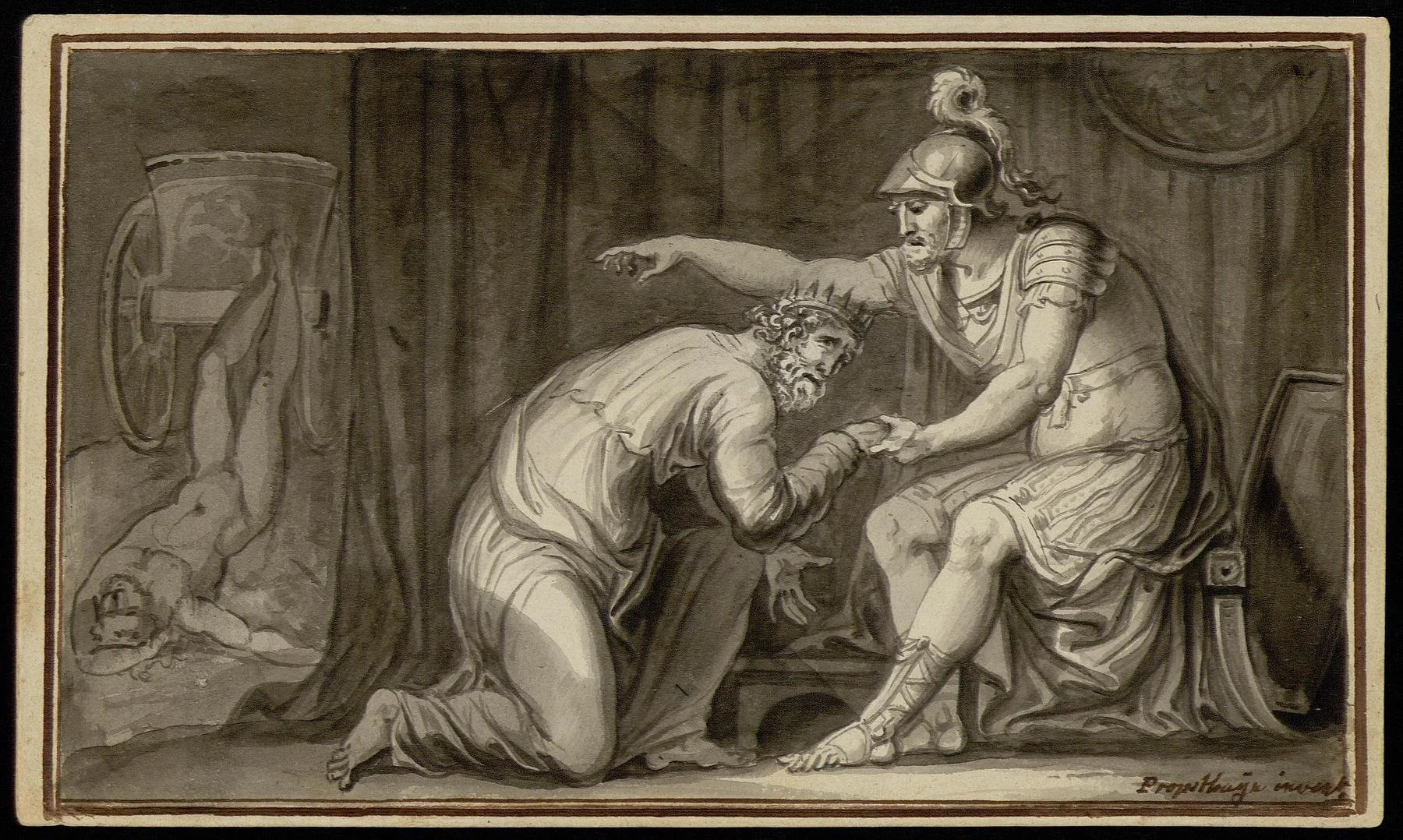
The final scene of the Iliad, where Achilles acquiesces to returning Hector’s body to his father King Priam
With this reading of the Iliad in mind, we turn our analysis to why this interpretation elevates our understanding of My Hero Academia and Midoriya’s character arc. The world of My Hero Academia is one where superpowers – or “quirks” – are increasingly commonplace. Superheroes have become a profession rather than a duty, as they earn salaries and join various “agencies” to defeat quirk-powered villains or perform rescue operations. In the opening scene of My Hero Academia, a background character is calling his boss, saying that villain just showed up and thus will be late for work. Heroism has now become just as banal as a minor inconvenience. Just as the Iliad defines the standard hero as someone who wins battlefield glory, a hero in My Hero Academia is initially portrayed as just another job, one that only those with the most powerful quirks e.g. All Might with this strength, Bakugo with his explosions, etc, are the most deserving of attaining.
In this context, Midoriya’s eventual answer to “what it means to be a hero” sees him rise above to a higher standard of heroism, in particular seen through how he engages with the series’ villains. The manga delivers heartbreaking deep dives into the backstories and motivations of its villains, much like how the Iliad paints Hector as a full human rather than a one-dimensional adversary. We learn that each villain’s motivations have uncomfortably relatable roots, from Dabi’s toxic family dynamics, to the denial of Himiko’s self-identity due to her unique quirk, to outright child abuse and generational trauma inflected on the main villain Shigaraki. As Midoriya and his class of heroes uncover the very human origins of these villains, they must grapple with whether simply vanquishing these supposed “evildoers” truly meets the standard of a real “hero,” or if there are alternative solutions that strike at the root cause of their villainy.

My Hero Academia rises above the “good” vs “evil” shounen trope by questioning whether heroism can go beyond just vanquishing the “bad guys”
Thus, when Midoriya resolves to “save” the “crying boy” that he sees inside Shigaraki’s mind, he is invoking the same spirit that led Achilles to his own ascension to a true hero. During the final battle, Midoriya dives into Shigaraki’s consciousness to witness the exact point of trauma that set him on the path to becoming a villain – that of accidentally killing his family through his “Decay” quirk channeled through his hands. In that moment, despite Shigaraki being the man who murdered Midoriya’s mentors and reduced cities to dust, Midoriya once again leapt without hesitation to grasp Shigaraki’s hands, because in his words, “others have done the same for me.” By literally embracing his ultimate villain, Midoriya echoes Achilles’s legacy of seeing the humanity in those you are saving. He looked at Shigaraki and saw a child that no one comforted in time, just as Achilles looked at the king who came for his enemy's body and sees, instead of an enemy's father, a father. In both cases, the act of heroism is an act of recognizing the other’s pain, and deeming them worthy of being saved, because that pain could have happened to anyone. That’s going beyond just being a “pro hero”– that’s the real “Plus Ultra.”

Midoriya (right) in child form as he approaches Shigaraki’s (left) traumatized inner child
At the end of the day, both the Iliad and My Hero Academia seem to be saying that despite your powers, despite your martial prowess, being a hero isn’t about the monsters you vanquished or even the number of people you saved. Despite being from two completely separate civilizations and 3000 years apart, their common definition of heroism revolves seeing and acting upon the shared humanity between yourself and others. In other words, being a hero is open to all, as seen by the Midoriya leaping to save his friend, whether or not he had a quirk, or by two men seeing each other not as demi-god and king, but as a father and a son. That’s why the tagline of My Hero Academia resounds through the ages, and is the perfect vessel for the Iliad’s legacy – “You can be a hero,” because when one recognizes the worth of the shared humanity of others, we can all be heroes.
Sources & notes:
[1] The Iliad, Book 20, lines 557-561
[2] The Iliad, Book 1, lines 2-3
[3] It can be argued that Achilles has an understandable reason for his reaction; given that Achilles chose his destiny to have a “short but glorious” life, a denial of his glory is a denial of him as an individual, for glory is all that he is destined to live for.
[4] The Iliad, Book 6, lines 556-566